The False Normal: Why a Perfect TSH Can Still Be Hiding Dysfunction
Jul 27, 2026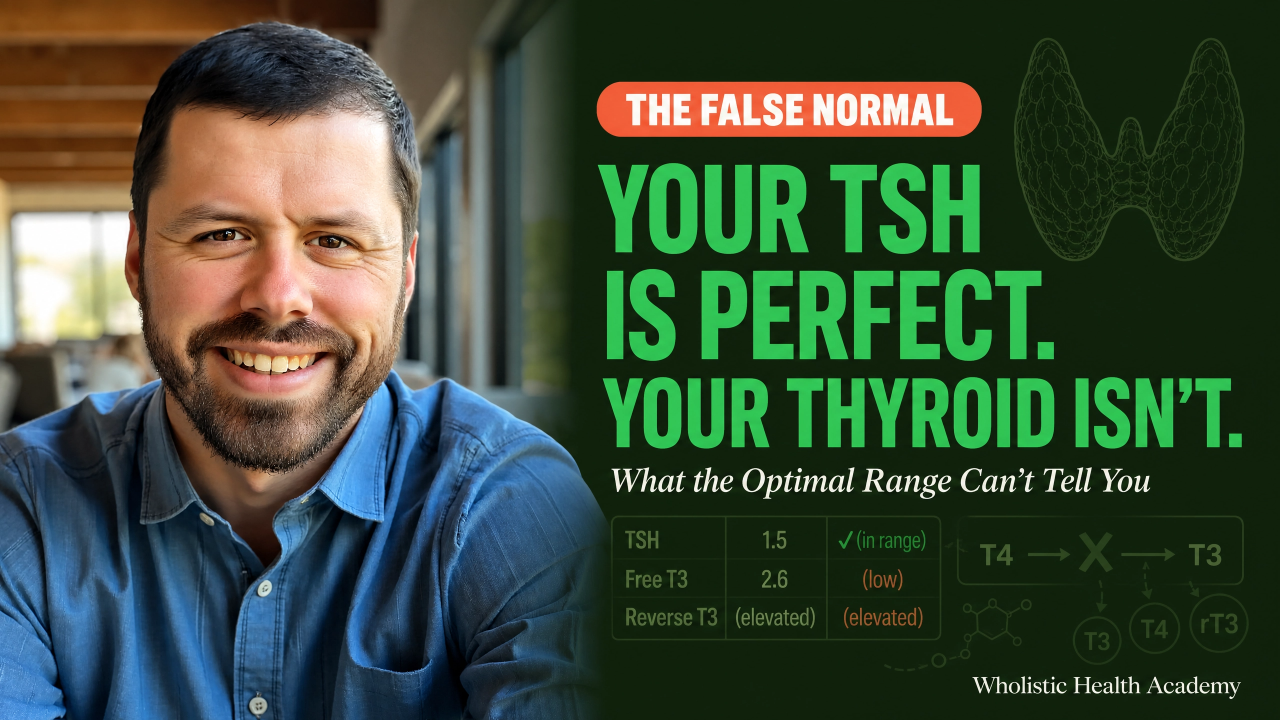
The False Normal: Why a Perfect TSH Can Still Be Hiding Dysfunction
By Michael Rutherford
You already left conventional ranges behind. You know a TSH of 4.0 isn't "fine." But here's the harder truth: a TSH sitting at a flawless, optimal 1.5 can still be a false normal — reassuring you that a thyroid is healthy when the client in front of you is anything but. The problem was never just the range. It's the marker itself.
An Optimal TSH Is Not Proof of a Healthy Thyroid
Moving from conventional ranges to optimal ranges is one of the most important upgrades a practitioner makes. It catches the subclinical hypothyroidism that a conventional lab waves through, and it should. But it also creates a subtler trap: the belief that once a marker sits inside the optimal range, that marker has been cleared. For TSH, that belief is a false normal waiting to happen.
A TSH of 1.5 looks perfect. In isolation, it reads as a thyroid doing exactly what it should. Yet that same 1.5 can sit directly on top of a low Free T4 and a low Free T3 — a genuinely hypothyroid picture at the tissue level, hiding beneath an optimal pituitary number.1 The range didn't fail. The marker did, because TSH was never measuring the thing you actually care about.
TSH Is a Pituitary Signal, Not a Thyroid One
This is the root of the entire problem. TSH — thyroid stimulating hormone — is not made by the thyroid. It's made by the pituitary, and it represents the pituitary's request for thyroid hormone, not the amount of active hormone actually reaching the cells. A normal TSH tells you the pituitary is satisfied with the feedback it's receiving. It does not tell you that active hormone is being produced, converted, transported, and delivered to the tissues that need it.
There's an added layer that makes population ranges even less reliable here: thyroid function is highly individual. Each person has a narrow personal set-point, and research shows the individual variation in thyroid hormones is far tighter than the population reference range — meaning a TSH that sits comfortably in the middle of "optimal" for the population can still be meaningfully abnormal for a specific person.2 An optimal number, in other words, is a statement about a population, not a verdict on the client in your chair.
It's Also the Last Marker to Move
Even when TSH does eventually reflect dysfunction, it does so late. TSH is the last of the thyroid markers to shift: symptoms appear first, Free T3 and Free T4 change next, and TSH only drifts once the dysfunction is well established. That sequence means an optimal TSH is often reassurance that arrives before the truth does — the periphery is already struggling while the pituitary's signal still reads clean.
Put the three facts together and the false normal becomes almost predictable. TSH measures upstream signaling rather than downstream delivery, its optimal range is a population statistic rather than a personal one, and it lags behind the very dysfunction you're trying to catch. An optimal TSH clears the pituitary. It does not clear the thyroid.
This is exactly what my next training is about.
Join my free live webinar on the dysfunction hiding inside "normal" labs — Wed, July 29th, 10am PT.
Where the Dysfunction Hides Behind an Optimal TSH
If an optimal TSH can coexist with real thyroid dysfunction, the obvious question is where that dysfunction is hiding. Consider the client this describes: fatigued, cold, losing hair, unable to shift her weight no matter what she does. Her TSH comes back at 1.5 and her Free T4 at 1.4 — both textbook optimal — and a range-focused practitioner reassures her that her thyroid is fine. But her Free T3 sits at 2.6, near the very bottom of its range, and her reverse T3 is elevated. Her symptoms had an explanation the entire time; the TSH simply couldn't show it. Three patterns account for most of these cases, and none of them disturb TSH until late.
Poor conversion — the most common pattern of all. Roughly 80% of the active hormone T3 is produced not by the thyroid but by peripheral conversion of T4, carried out by selenium-dependent deiodinase enzymes.3 When that conversion falters — from stress, inflammation, blood sugar dysregulation, or nutrient gaps — T4 is diverted toward inactive reverse T3 instead of active T3. The result is a client with an optimal TSH, an optimal or even high Free T4, and a low Free T3 with elevated reverse T3: the gland is working, the pituitary is satisfied, and the active hormone still never arrives. This pattern is missed constantly, because conventional panels omit the very markers that reveal it.
Central and stress-driven patterns. When chronic stress downregulates the signaling axis, the pituitary can quiet its output — producing a low or low-normal TSH alongside low T4 and low T3. Here the "normal" TSH isn't just uninformative, it's actively misleading, because the dysfunction lives above the thyroid, at the level of the brain's signaling.4 This is protective physiology, not gland failure, and TSH alone will never show it to you.
Non-thyroidal illness. Systemic illness and inflammation suppress T3 and raise reverse T3 while TSH stays in range — a picture of the body deliberately downshifting metabolism.5 Again, the pituitary marker looks calm while the peripheral hormones tell the real story.
Why the Gland Is Usually Innocent
What these patterns share is that the thyroid gland itself is often working fine. The conversion of T4 into active T3 happens largely outside the gland, and it's exquisitely sensitive to the body's wider state — which means the dysfunction you're chasing frequently isn't a thyroid problem at all. Two forces disrupt conversion more than any others. The first is chronic stress: elevated cortisol shunts T4 toward reverse T3 instead of active T3. The second is blood sugar dysregulation. Insulin resistance impairs the deiodinase enzymes that produce active T3 while simultaneously upregulating the enzyme that produces reverse T3,3 which is a large part of why blood sugar sits at the foundation of any thyroid assessment.
The practical consequence is significant: a TSH that looks optimal while Free T3 languishes is frequently a metabolic story wearing a thyroid label. No amount of thyroid-specific support will resolve it until the terrain underneath — blood sugar, stress, and the nutrient cofactors conversion depends on — is addressed. Reach for thyroid support in this setting and you're treating the marker instead of the mechanism, and the elevated reverse T3 will simply degrade what you add. This is exactly why the whole panel, read together, outperforms any single number chased in isolation.
What Actually Clears the Thyroid
The companion markers that unmask the false normal are the ones a TSH- only screen leaves out. Free T3 is the single most important, because it reflects the active hormone available to tissue — the thing TSH only indirectly implies.6 Reverse T3 differentiates a conversion or inflammatory problem from a simple deficiency. And thyroid antibodies catch early autoimmunity that can be underway for years before any hormone value, TSH included, moves at all.
That last point deserves its own emphasis, because it may be the most consequential false normal of all. A client with an optimal TSH, normal Free T4 and T3, and positive TPO or thyroglobulin antibodies is not healthy — they are in the earliest, most reversible phase of an autoimmune process that will eventually erode the gland. This euthyroid autoimmune window is precisely the moment intervention matters most, and it's the moment a TSH-only screen closes without ever opening. By the time TSH finally rises, years of destruction have often already occurred. Antibodies are the difference between catching the process early and meeting it late.
None of this means TSH is useless — it's a valuable part of the picture. It means TSH cannot be trusted alone, and that an optimal TSH is a beginning, not a conclusion. For the full method of reading these markers together, see our guide to interpreting a thyroid panel beyond TSH, and for the specific role of reverse T3, our breakdown of what elevated reverse T3 actually tells you.
The broader lesson reaches well past the thyroid. The false normal is not a problem you solve by tightening a range, because the range was never the issue — trusting a single marker to answer a question it can't was. This is the entire premise of reading blood chemistry as an interconnected system: markers confirm and contradict one another, and a value is only as trustworthy as the companions read beside it. Support the terrain the fuller pattern points to, educate the client, investigate the markers TSH can't see, and refer when findings warrant it. An optimal number opens the question. The companion markers answer it.
FREE Live Webinar · Wednesday, July 29th · 10am PT
The Hidden Patterns Inside "Normal" Labs
An optimal TSH hiding a hypothyroid client is just one false normal. In this live training, I'll show you how to spot the dysfunction hiding inside normal-range results across the whole panel — and read the markers that tell the real story. Save your spot for Wednesday, July 29th at 10am PT.
Save Your SeatFor health coaches, NTPs, FDN-Ps, and nutrition professionals.
Frequently Asked Questions
Can you have thyroid dysfunction with an optimal TSH?
Yes. TSH is a pituitary signal, not a direct measure of thyroid hormone reaching the tissues, so an optimal TSH can sit on top of a low Free T3, a high reverse T3, or positive antibodies. A perfect TSH clears the pituitary's feedback loop — it does not confirm that active hormone is being produced, converted, and delivered where it's needed.
Why is TSH considered the last marker to change?
Because symptoms and the peripheral hormones shift before the pituitary adjusts its output. Free T3 and Free T4 move earlier, and TSH only drifts once dysfunction is well established. This lag is why an optimal TSH can offer false reassurance while the tissue-level picture is already compromised.
What is the most common pattern an optimal TSH misses?
Poor T4-to-T3 conversion. Most active hormone is made by peripheral conversion, so when that process falters, a client can show an optimal TSH and a good Free T4 while Free T3 runs low and reverse T3 runs high. Because conventional panels frequently omit Free T3 and reverse T3, this common pattern is routinely missed.
Which markers should be read alongside TSH?
Free T3 above all, since it reflects the active hormone available to tissue. Reverse T3 helps distinguish a conversion or inflammatory problem from a deficiency, and thyroid antibodies catch early autoimmunity that can precede any change in hormone levels. Together they turn an optimal TSH from a conclusion into a starting point — and turn a client who was told she's "fine" into one whose picture finally makes sense.
References
- Chaker, L., Bianco, A. C., Jonklaas, J., & Peeters, R. P. (2017). Hypothyroidism. The Lancet, 390(10101), 1550-1562. https://doi.org/10.1016/S0140-6736(17)30703-1
- Andersen, S., Pedersen, K. M., Bruun, N. H., & Laurberg, P. (2002). Narrow individual variations in serum T4 and T3 in normal subjects: A clue to the understanding of subclinical thyroid disease. Journal of Clinical Endocrinology & Metabolism, 87(3), 1068-1072. https://doi.org/10.1210/jcem.87.3.8165
- Bianco, A. C., Salvatore, D., Gereben, B., Berry, M. J., & Larsen, P. R. (2002). Biochemistry, cellular and molecular biology, and physiological roles of the iodothyronine selenodeiodinases. Endocrine Reviews, 23(1), 38-89. https://doi.org/10.1210/ edrv.23.1.0455
- Persani, L. (2012). Central hypothyroidism: Pathogenic, diagnostic, and therapeutic challenges. Journal of Clinical Endocrinology & Metabolism, 97(9), 3068-3078. https://doi.org/ 10.1210/jc.2012-1616
- Warner, M. H., & Beckett, G. J. (2010). Mechanisms behind the non-thyroidal illness syndrome: An update. Journal of Endocrinology, 205(1), 1-13. https://doi.org/10.1677/JOE-09-0412
- Gullo, D., Latina, A., Frasca, F., Le Moli, R., Pellegriti, G., & Vigneri, R. (2011). Levothyroxine monotherapy cannot guarantee euthyroidism in all athyreotic patients. PLoS ONE, 6(8), e22552. https://doi.org/10.1371/journal.pone.0022552
