Ferritin: The Most Misunderstood Marker in Blood Chemistry
Jun 01, 2026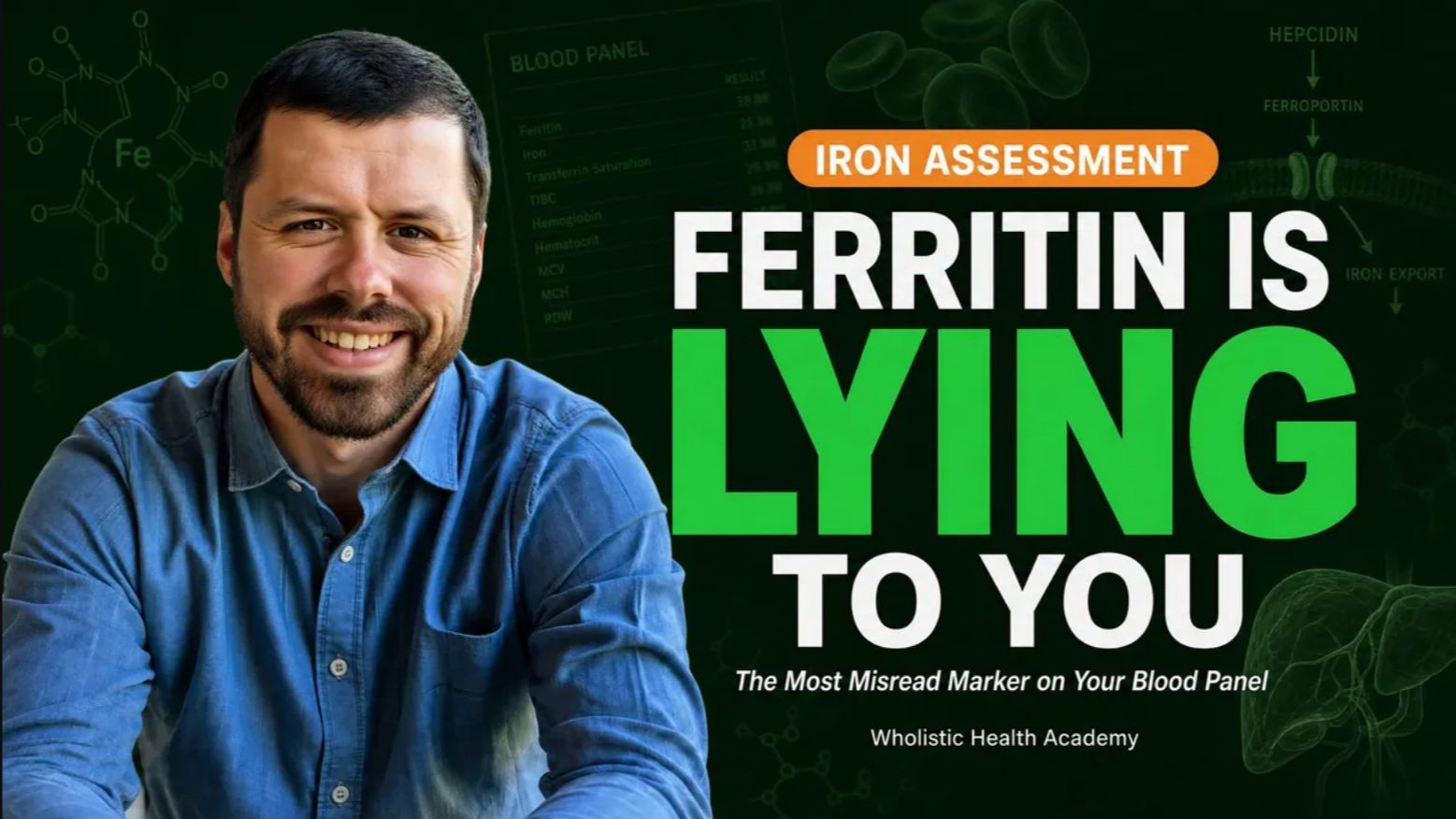
Ferritin: The Most Misunderstood Marker in Blood Chemistry
By Michael Rutherford
Ferritin sits on nearly every panel, gets filed under "nutrient markers," and is treated as a clean readout of iron in storage. But ferritin wears two hats — an iron storage protein and an acute phase reactant — and nearly every clinical misread traces back to forgetting which hat it is wearing at the moment the blood was drawn.
Why Ferritin Is So Easy to Misread
Most laboratory markers do one job. Ferritin does two, and they pull in different directions. As an intracellular iron storage protein, serum ferritin loosely reflects total body iron stores. As an acute phase reactant, ferritin rises in response to inflammation, infection, liver injury, and metabolic dysfunction — entirely independent of iron status.1
This is not a minor caveat. It is the defining feature of the marker. A single ferritin value cannot tell you which of its two roles is dominant at the moment of the draw, which means a ferritin reported in isolation is closer to a question than an answer. The clinical errors that follow are not exotic edge cases. They are routine, and they happen in both directions — practitioners who over-supplement iron on a falsely low reading, and practitioners who dismiss true deficiency on a falsely reassuring one.
The Mechanism That Explains the Confusion
The reason ferritin behaves this way comes down to hepcidin, the master regulatory hormone of iron homeostasis. When the body detects inflammation, inflammatory cytokines — interleukin-6 chief among them — stimulate hepcidin production in the liver.2 Hepcidin then degrades ferroportin, the channel that exports iron out of storage cells and into circulation.
The downstream effect is twofold. Iron gets trapped inside macrophages and hepatocytes, lowering serum iron, while ferritin synthesis is simultaneously upregulated as part of the same inflammatory program.3 The result is the hallmark inflammatory iron picture: a rising ferritin sitting over a falling serum iron. The stores appear to be filling while the functionally available iron is actually dropping. Without understanding this mechanism, the pattern looks contradictory. With it, the pattern becomes one of the most informative signals on the panel.
Clinical Pearl: A high ferritin with a low serum iron is not a paradox. It is the signature of inflammation-driven iron sequestration — hepcidin trapping iron in storage while the inflammatory program drives ferritin synthesis upward. The two markers moving in opposite directions is the diagnostic information.
Ready to go deeper than this post can take you?
Mastering the Art of Functional Blood Chemistry is the in-depth practitioner course for pattern recognition and root cause clinical reasoning.
Misuse One: Reading Ferritin in Isolation
The foundational error is interpreting ferritin without ever establishing whether inflammation is present. This is the error from which most of the others descend. Ferritin functions much like CRP in its responsiveness to systemic inflammatory signaling, and a client with autoimmune disease, an active or smoldering infection, metabolic syndrome, or significant adiposity can carry a meaningfully elevated ferritin that says nothing about iron stores.4
The discipline here is simple to state and frequently skipped in practice: ferritin is never interpreted alone. It is read alongside serum iron, total iron-binding capacity, transferrin saturation, and the inflammatory context — hs-CRP, but also the broader clinical picture. A ferritin value without its supporting panel is not actionable, no matter how confident the number looks.
Misuse Two: Assuming High Ferritin Means Replete Iron
This is the misuse that does the quietest harm, because it ends an investigation that should have continued. A client presents with fatigue and a normal-to-high ferritin, the practitioner concludes iron is adequate, and the real driver goes unexamined.
Elevated ferritin over a low serum iron is the defining picture of anemia of chronic disease — the same hepcidin-mediated sequestration described above.5 Total body iron may be adequate or even elevated, but the iron is locked away from erythropoiesis and cellular metabolism. Treating the ferritin as evidence of sufficiency misses the functional deficiency entirely, and supplementing iron into an inflammatory state can worsen oxidative burden without resolving the underlying problem.
The metabolic version of this misuse is just as common. Elevated ferritin is an independent predictor of histologic severity and advanced fibrosis in non- alcoholic fatty liver disease, frequently in the complete absence of true iron overload.6 In a client with metabolic syndrome, an elevated ferritin may be reporting on hepatic stress and insulin resistance rather than iron at all. The number is real; the interpretation as "iron stores" is the error.
Misuse Three: Jumping From High Ferritin to Iron Overload
The mirror-image error is treating every elevated ferritin as presumptive hemochromatosis or iron overload. Ferritin is not the lead marker in overload assessment — transferrin saturation is. Genuine iron overload presents with the entire iron panel pushing in the same direction: elevated ferritin alongside elevated serum iron and elevated saturation, typically above 45%.
Worth noting on the referral question: a saturation in the 45–55% range still sits within most conventional lab reference ranges, so reflexively referring at 50% often results in a client being told nothing is wrong — which erodes credibility. The more useful posture is to investigate the cause when the overload pattern appears, reserving referral for markedly elevated saturation or a clearly confirmed overload picture across the panel.
Inflammatory ferritin presents very differently — a high ferritin sitting over a normal or low serum iron, with saturation that is normal or low rather than elevated. The direction of the panel as a whole is the differentiator, not the ferritin value in isolation.
A practical heuristic:
In US units, ferritin should rarely exceed serum iron. When ferritin approaches or surpasses serum iron — for example a serum iron of 50 μg/dL beneath a ferritin of 80 ng/mL — that relationship points toward inflammation rather than abundance, often before any inflammatory marker is formally elevated.
It is also worth noting that hs-CRP alone does not reliably settle the overload-versus-inflammation question. CRP can remain unremarkable in low- grade, localized, or certain chronic inflammatory states — mold-related illness being one frequently cited example. The direction of the iron panel is the more dependable differentiator than any single inflammatory marker.
Misuse Four: Trusting a "Normal" Ferritin in an Inflamed Client
Because inflammation pushes ferritin upward, a genuine iron deficiency can hide behind a ferritin that reads as perfectly normal. The inflammatory signal inflates the number just enough to mask the depletion underneath, and the deficiency goes undiagnosed.7
This is the scenario where soluble transferrin receptor (sTfR) becomes indispensable. Unlike ferritin, sTfR rises in true tissue iron deficiency and is not affected by the inflammatory state.8 The sTfR-to-log-ferritin index — sometimes called the TfR-ferritin index — leverages this property to separate genuine iron deficiency from anemia of chronic disease with far more accuracy than either marker alone.9 When a client looks iron-deficient on clinical grounds but ferritin reads normal, inflammation is the first thing to rule out, and sTfR is the marker that does it.
Misuse Five: The "Ferritin Should Be 90+" Target
A specific number circulates widely in practitioner communities: ferritin should be at least 90 ng/mL, sometimes higher, for optimal function. The recommendation is well-intentioned and, in the wrong population, actively misleading.
The elevated-target reasoning largely traces back to research in inflammatory bowel disease and similar inflammatory conditions, where higher ferritin cutoffs were proposed precisely because inflammation was masking true iron deficiency. In that specific context, a higher threshold makes sense — a ferritin of 40 in an actively inflamed IBD patient may genuinely reflect depletion. Guidelines for these populations explicitly raise the ferritin cutoff for exactly this reason.10
The error is generalizing that adjusted threshold to healthy, non-inflamed clients who do not share the underlying physiology. Applying an inflammation- corrected cutoff to someone without inflammation pushes practitioners toward iron supplementation that may be unnecessary — and, given iron's role in oxidative stress, not without cost. The target should reflect the client in front of you, not a threshold derived from a fundamentally different population.
The Same Elevated Ferritin, Four Different Stories
Nothing illustrates the dual-nature problem better than seeing how a single elevated ferritin resolves into four entirely different clinical situations depending on the rest of the panel.
| Underlying Reality | Serum Iron | Transferrin Sat | Clinical Direction |
|---|---|---|---|
| True iron overload | High | High (>45%) | Investigate cause — refer if markedly elevated |
| Anemia of chronic disease | Low | Low | Address inflammation first |
| Iron recycling dysfunction | Low | Low | Address inflammation / hepcidin |
| Metabolic / fatty liver | Normal | Normal | Address insulin resistance |
Four identical ferritin elevations. Four completely different interventions — one of which (anemia of chronic disease) would be actively worsened by the iron supplementation the ferritin might seem to invite if read alone, while another (overload) calls for investigating the underlying cause rather than supplementing. This is the entire argument for pattern recognition over single-marker interpretation, expressed in one marker.
Reading Ferritin Correctly
The discipline that prevents all five misuses is the same: ferritin is interpreted within the full iron panel and the inflammatory context, never on its own. Establish whether inflammation is present. Read serum iron and transferrin saturation alongside the ferritin to determine which direction the panel is pointing. Lead overload assessment with saturation, not ferritin. Reach for soluble transferrin receptor when inflammation may be masking deficiency. And set functional targets — a range near 30–125 ng/mL for most clients — based on the individual rather than on thresholds borrowed from inflammatory-disease populations.
For the broader framework this sits within, our practitioner's guide to iron panel interpretation walks through the complete panel, and what iron overload actually looks like on labs covers the high end of the spectrum in depth.
Ferritin is not a bad marker. It is a profoundly useful one — but only for the practitioner who remembers it is doing two jobs at once and reads it accordingly. The marker isn't misunderstood because it's unreliable. It's misunderstood because it's routinely asked to answer a question it can only answer with help.
Build the Clinical Reasoning Toolkit
Master the Art of Functional Blood Chemistry
Ferritin is one marker among many that demand pattern recognition rather than isolated interpretation. Mastering the Art of Functional Blood Chemistry teaches the complete clinical reasoning system — how markers interrelate, where the common errors hide, and how to read the panel as an integrated whole.
Explore the CourseFor health coaches, NTPs, FDN-Ps, and nutrition professionals.
Frequently Asked Questions
Is ferritin a reliable marker of iron stores?
Only in the absence of inflammation. In a metabolically healthy, non-inflamed individual, ferritin reflects iron stores reasonably well. Once inflammation, infection, liver stress, or significant metabolic dysfunction is present, ferritin can rise independently of iron status — which is why it is always interpreted alongside serum iron, transferrin saturation, and inflammatory context rather than on its own.
Why would ferritin be high while a client is genuinely iron-deficient functionally?
Through hepcidin-mediated sequestration. Inflammatory cytokines drive hepcidin, which traps iron inside storage cells while simultaneously upregulating ferritin synthesis. Total iron may be adequate, but it is locked away from erythropoiesis and cellular metabolism. The tell is a low serum iron sitting beneath a normal-to-high ferritin — and soluble transferrin receptor, unaffected by inflammation, helps confirm whether true deficiency coexists.
Should ferritin be at least 90 ng/mL for optimal health?
Not as a universal target. The elevated-cutoff reasoning derives from inflammatory bowel disease and similar inflammatory conditions, where higher thresholds were adopted specifically because inflammation masks true deficiency. Applying that inflammation-corrected number to healthy, non-inflamed clients generalizes data from a fundamentally different population and can push toward unnecessary iron supplementation.
Which marker leads in iron overload assessment, ferritin or saturation?
Transferrin saturation. True overload presents with the whole panel elevated together — ferritin, serum iron, and saturation, the latter typically above 45%. An isolated high ferritin with normal or low serum iron points toward inflammation, not overload. Ferritin is a supporting marker in overload assessment, not the lead.
Does a normal hs-CRP rule out inflammatory ferritin?
No. CRP can remain unremarkable in low-grade, localized, or certain chronic inflammatory states. Relying on a single inflammatory marker to clear ferritin is unreliable. The direction of the iron panel as a whole — every marker elevated together versus a high ferritin over a low serum iron — is the more dependable way to distinguish inflammatory ferritin from genuine iron abundance.
References
- Knovich, M. A., Storey, J. A., Coffman, L. G., Torti, S. V., & Torti, F. M. (2009). Ferritin for the clinician. Blood Reviews, 23(3), 95-104. https://doi.org/10.1016/j.blre.2008.08.001
- Nemeth, E., Rivera, S., Gabayan, V., Keller, C., Taudorf, S., Pedersen, B. K., & Ganz, T. (2004). IL-6 mediates hypoferremia of inflammation by inducing the synthesis of the iron regulatory hormone hepcidin. Journal of Clinical Investigation, 113(9), 1271-1276. https://doi.org/10.1172/JCI20945
- Ganz, T. (2012). Hepcidin and iron homeostasis. Biochimica et Biophysica Acta, 1823(9), 1434-1443. https://doi.org/10.1016/j.bbamcr.2012.01.014
- Cassat, J. E., & Skaar, E. P. (2013). Iron in infection and immunity. Cell Host & Microbe, 13(5), 509-519. https://doi.org/10.1016/j.chom.2013.04.010
- Weiss, G., & Goodnough, L. T. (2005). Anemia of chronic disease. New England Journal of Medicine, 352(10), 1011-1023. https://doi.org/10.1056/NEJMra041809
- Kowdley, K. V., Belt, P., Wilson, L. A., Yeh, M. M., Neuschwander-Tetri, B. A., Chalasani, N., ... Lavine, J. E. (2012). Serum ferritin is an independent predictor of histologic severity and advanced fibrosis in patients with nonalcoholic fatty liver disease. Hepatology, 55(1), 77-85. https:// doi.org/10.1002/hep.24706
- Hershko, C., & Camaschella, C. (2014). How I treat unexplained refractory iron deficiency anemia. Blood, 123(3), 326-333. https://doi.org/10.1182/blood-2013-10-512624
- Punnonen, K., Irjala, K., & Rajamäki, A. (1997). Serum transferrin receptor and its ratio to serum ferritin in the diagnosis of iron deficiency. Blood, 89(3), 1052-1057. https://doi.org/10.1182/ blood.V89.3.1052
- Skikne, B. S., Punnonen, K., Caldron, P. H., Bennett, M. T., Rehu, M., Gasior, G. H., ... Cook, J. D. (2011). Improved differential diagnosis of anemia of chronic disease and iron deficiency anemia: A prospective multicenter evaluation of soluble transferrin receptor and the sTfR/log ferritin index. American Journal of Hematology, 86(11), 923-927. https:// doi.org/10.1002/ajh.22108
- Dignass, A. U., Gasche, C., Bettenworth, D., Birgegård, G., Danese, S., Gisbert, J. P., ... Stein, J. (2015). European consensus on the diagnosis and management of iron deficiency and anaemia in inflammatory bowel diseases. Journal of Crohn's and Colitis, 9(3), 211-222. https:// doi.org/10.1093/ecco-jcc/jju009
