Iron Deficiency Without Anemia: Why a Normal CBC Isn't Enough
Jul 06, 2026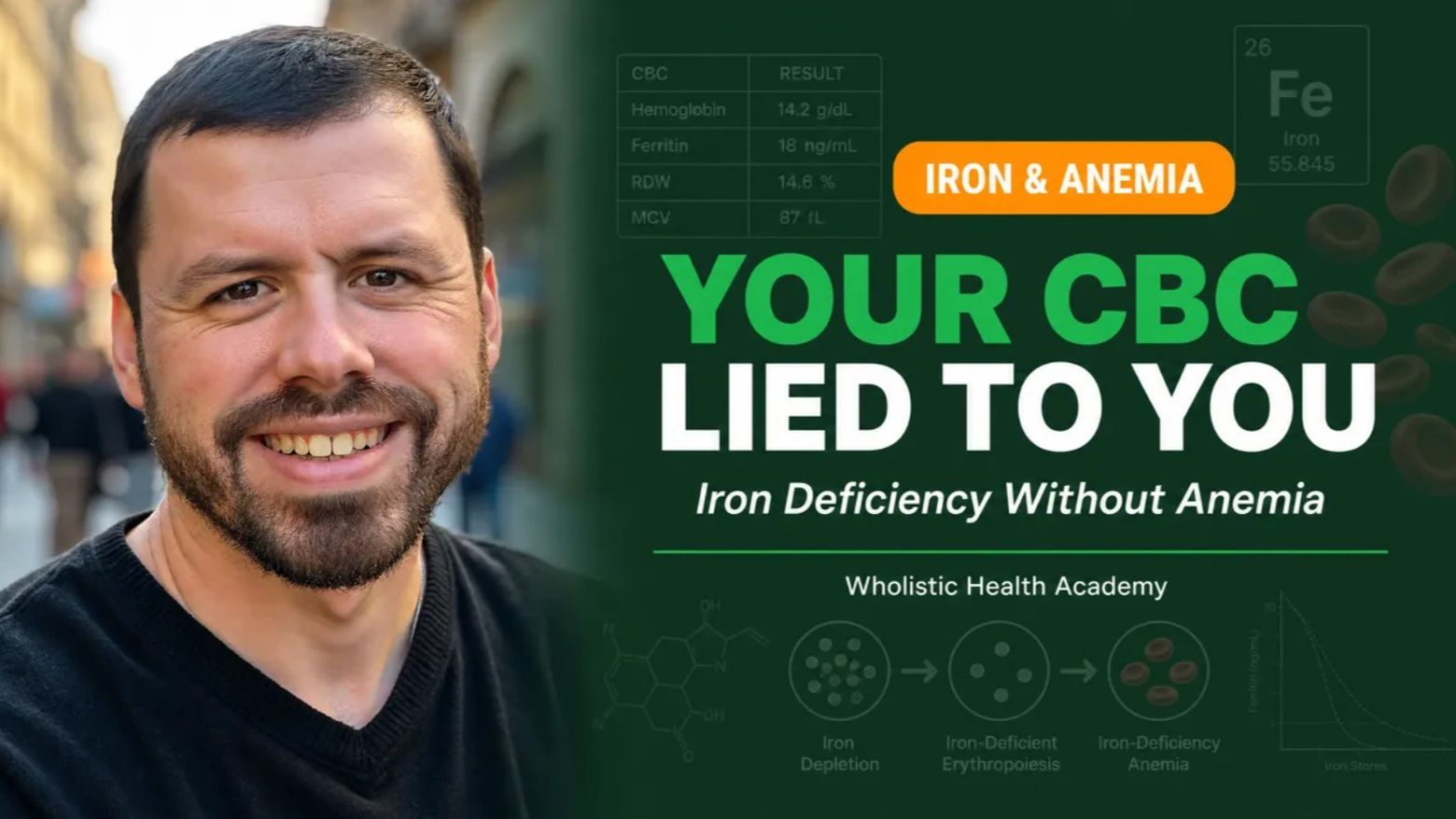
Iron Deficiency Without Anemia: Why a Normal CBC Isn't Enough
By Michael Rutherford
Anemia is not the first sign of iron deficiency — it's the last. It's the final stage of a process that has usually been unfolding for months or years, with the client symptomatic the entire time. Which means the most important iron deficiency you'll ever catch is the one a standard CBC calls perfectly normal.
Iron Deficiency and Anemia Are Distinct Conditions
This is the single most important distinction in iron assessment, and it's the one conventional interpretation collapses. Iron deficiency and anemia are not the same thing. They are two separate conditions that happen to overlap at the far end of a progression — and you can have either one without the other.1 There is iron deficiency without anemia. There is anemia without iron deficiency. There is iron-deficiency anemia, where both are present. And there is even elevated iron coexisting with anemia. Treating "normal hemoglobin" as proof of adequate iron collapses four distinct clinical situations into one, and misses the most common and most treatable of them.
The reason this matters so much in practice is timing. A client can be meaningfully iron-deficient — fatigued, losing hair, breathless on exertion, struggling to recover from workouts — while hemoglobin sits squarely in range and the CBC reads as unremarkable. Anemia develops only once iron stores are so depleted that the body can no longer manufacture normal red blood cells. Long before that threshold, iron has already fallen far enough to affect how the client feels and functions.
The Three Stages of Iron Deficiency
Iron deficiency is not an event; it's a progression through three defined stages. Understanding them is what lets you intervene at the beginning rather than the end — and a standard CBC stays normal through most of the journey.2
| Stage | Ferritin | Serum Iron | RDW | MCV / Hgb | CBC Verdict |
|---|---|---|---|---|---|
| 1 · Depletion | Dropping | Normal | Normal | Normal | "Normal" |
| 2 · Iron-Deficient Erythropoiesis | Low | Falling | Rising | MCV normal, Hgb slipping | Often still "normal" |
| 3 · Iron Deficiency Anemia | Very low | Low | Elevated | MCV low, Hgb low | Finally flags |
Stage 1 — Depletion. Iron stores are drawn down and ferritin drops, while serum iron and the entire CBC remain normal. The client may already be symptomatic, but every conventional marker offers reassurance. This is the earliest and most valuable window to act — the point where food-first, root-cause support is most effective and least invasive.
Stage 2 — Iron-Deficient Erythropoiesis. Stores are now exhausted, and the bone marrow begins running short on the iron it needs to build red cells. RDW starts to rise and hemoglobin begins a slow slip, but MCV frequently remains within range — so the CBC still often reads as normal, and the deficiency continues to be missed.
Stage 3 — Iron Deficiency Anemia. Only here does the textbook picture emerge: low hemoglobin, low MCV, a very low ferritin, and a high TIBC as the body signals its hunger for iron. This is the stage conventional screening is designed to detect — and by definition, it's the stage at which the deficiency has already progressed the furthest.
Clinical Pearl: A "normal" CBC rules out anemia. It does not rule out iron deficiency. Those are different questions, and conflating them is how a symptomatic, iron-depleted client gets told everything looks fine — sometimes for years before their hemoglobin finally falls far enough to be noticed.
Learn to read iron — and 50+ markers.
Blood Chemistry 101 gives you the foundational framework for reading any panel with confidence.
Why Does the CBC Miss Early Iron Deficiency?
The answer lies in the lifespan of a red blood cell. A red cell circulates for roughly 120 days, and the CBC measures the population of cells you already have. In early deficiency, the vast majority of those cells were manufactured back when iron was still adequate — so they are normal in size and color. Only the newest cells, built under a shortage, emerge small and pale. Because they're a minority of the total, they don't move the average (MCV) or the hemoglobin much at first.
What they do move is RDW — red cell distribution width, the measure of variation in cell size. As a small population of undersized new cells joins the normal-sized old ones, the spread of sizes widens, and RDW rises before MCV or hemoglobin change at all.2,3 This makes RDW one of the earliest and most underused signals on the entire CBC. Most practitioners glance past it; it's often the first number to whisper that iron is running out.
Ferritin, meanwhile, is the true early sentinel, because it reflects iron stores — and stores are the first thing the body draws down. Circulating iron and red cell production are defended until stores are nearly gone, which is exactly why ferritin drops in Stage 1 while everything else holds. It also explains a finding that surprises many clients: randomized controlled trials have shown that non-anemic women with low ferritin and unexplained fatigue improve with iron repletion, even though their hemoglobin was normal throughout.4,5 The symptoms track the stores, not the anemia.
Which Markers Catch It Early?
Reading early iron deficiency well means looking past hemoglobin to the markers that move first. Ferritin is the anchor: a value of 40 clears most conventional reports without comment, but functional optimal sits at 30–125 ng/mL, and a ferritin scraping the floor of that range in a symptomatic client is a signal, not reassurance. Our practitioner's guide to iron panel interpretation details how the full panel fits together.
RDW rising ahead of MCV is the early CBC flag. TIBC trending high reflects a body actively reaching for more iron — high TIBC signals hunger, low TIBC signals blocked absorption. And soluble transferrin receptor (sTfR) is perhaps the most valuable early marker of all: it rises early in tissue iron deficiency and, unlike ferritin, is not distorted by inflammation.6,7 That inflammation-resistance is what makes sTfR so useful for separating true early iron deficiency from the falsely reassuring or falsely alarming ferritin values that inflammation produces.
This is also the crucial differential: elevated RDW points toward iron deficiency or a mixed picture, whereas a normal RDW alongside a normal-to-high ferritin and elevated inflammatory markers points instead toward anemia of chronic disease, where iron is present but locked away by inflammation rather than truly deficient.8 Reading these markers as a pattern — not one value at a time — is the entire discipline.
Catching It Early Is Only Half the Job
Identifying Stage 1 iron deficiency is the win. What you do next matters just as much, and here the functional approach diverges sharply from "just take iron." The majority of iron-deficiency cases involve cofactor gaps rather than a simple shortage of iron itself. Iron metabolism depends on a family of cofactors — copper, vitamin A, folate, B12, magnesium, vitamin D, B6, and zinc — and a deficiency in these can impair iron handling even when iron intake is adequate. Addressing the cofactors is often what resolves the picture, which is why food-first, cofactor-rich sources tend to outperform isolated iron, especially in these early stages.
Equally important is the question of cause. Significant or unexplained iron deficiency — particularly in men and post-menopausal women, who shouldn't be losing iron through menstruation — warrants investigating the source, since chronic blood loss is a common and sometimes serious driver, and referring when appropriate.9 Catching iron deficiency early is not a license to supplement reflexively; it's an opportunity to find and address the root, within scope, and to escalate when the pattern calls for it. For menstruating women, timing also matters: a serum iron drawn a few days after a period reads differently than the same value drawn late in the cycle, when stores should have recovered.
Newly Revamped · Available Now
Blood Chemistry 101
Iron is one of the trickiest patterns on the panel — and exactly the kind of reasoning Blood Chemistry 101 is built to teach. Learn the Three-Tier Decision Tree, pattern recognition, and a root-cause approach across 50+ markers, in a course you can complete in a single weekend.
Explore Blood Chemistry 101For health coaches, NTPs, FDN-Ps, and nutrition professionals.
Frequently Asked Questions
Can you be iron deficient with a normal CBC?
Yes, and it's common. Iron deficiency moves through three stages, and the CBC generally stays normal through the first two. In the depletion stage, iron stores — measured by ferritin — are already falling while hemoglobin, MCV, and the rest of the count remain in range. A normal CBC excludes anemia; it does not exclude iron deficiency.
What is the difference between iron deficiency and anemia?
Iron deficiency is a shortage of iron stores or available iron; anemia is a shortage of hemoglobin or red cell mass. Iron deficiency is earlier and more common, and can cause fatigue, hair loss, and exercise intolerance well before it becomes severe enough to lower hemoglobin. Anemia is the final stage of untreated iron deficiency, not its first sign.
Which lab marker detects iron deficiency earliest?
Ferritin, which reflects iron stores, is the earliest routine marker to fall. On the CBC itself, RDW usually rises before MCV or hemoglobin, because only the newest red cells reflect the shortage while older cells remain normal. Soluble transferrin receptor is another early marker and has the advantage of not being distorted by inflammation.
How is early iron deficiency different from anemia of chronic disease?
In early iron deficiency, ferritin is low and RDW tends to rise. In anemia of chronic disease, ferritin is normal or high and RDW is typically normal, because iron is present but sequestered by inflammation rather than truly deficient. Soluble transferrin receptor helps separate the two, since it rises in true deficiency but not in inflammation-driven iron sequestration.
Should iron always be supplemented when deficiency is found early?
Not automatically. Many cases involve cofactor gaps — copper, vitamin A, folate, B12, and others — rather than a simple iron shortage, so cofactor-rich, food-first support often works better than isolated iron. Significant or unexplained deficiency, especially in men or post-menopausal women, also warrants investigating the cause and referring when appropriate, since chronic blood loss is a common driver.
References
- Camaschella, C. (2019). Iron deficiency. Blood, 133(1), 30-39. https://doi.org/10.1182/ blood-2018-05-815944
- Short, M. W., & Domagalski, J. E. (2013). Iron deficiency anemia: Evaluation and management. American Family Physician, 87(2), 98-104.
- Lopez, A., Cacoub, P., Macdougall, I. C., & Peyrin-Biroulet, L. (2016). Iron deficiency anaemia. The Lancet, 387(10021), 907-916. https://doi.org/10.1016/S0140-6736(15)60865-0
- Verdon, F., Burnand, B., Fallab Stubi, C. L., Bonard, C., Graff, M., Michaud, A., ... Favrat, B. (2003). Iron supplementation for unexplained fatigue in non-anaemic women: Double blind randomised placebo controlled trial. BMJ, 326(7399), 1124. https://doi.org/10.1136/ bmj.326.7399.1124
- Vaucher, P., Druais, P. L., Waldvogel, S., & Favrat, B. (2012). Effect of iron supplementation on fatigue in nonanemic menstruating women with low ferritin: A randomized controlled trial. CMAJ, 184(11), 1247-1254. https://doi.org/10.1503/cmaj.110950
- Skikne, B. S., Punnonen, K., Caldron, P. H., Bennett, M. T., Rehu, M., Gasior, G. H., ... Cook, J. D. (2011). Improved differential diagnosis of anemia of chronic disease and iron deficiency anemia: A prospective multicenter evaluation of soluble transferrin receptor and the sTfR/log ferritin index. American Journal of Hematology, 86(11), 923-927. https:// doi.org/10.1002/ajh.22108
- Punnonen, K., Irjala, K., & Rajamäki, A. (1997). Serum transferrin receptor and its ratio to serum ferritin in the diagnosis of iron deficiency. Blood, 89(3), 1052-1057. https://doi.org/10.1182/ blood.V89.3.1052
- Weiss, G., & Goodnough, L. T. (2005). Anemia of chronic disease. New England Journal of Medicine, 352(10), 1011-1023. https://doi.org/10.1056/NEJMra041809
- Goddard, A. F., James, M. W., McIntyre, A. S., & Scott, B. B. (2011). Guidelines for the management of iron deficiency anaemia. Gut, 60(10), 1309-1316. https://doi.org/10.1136/ gut.2010.228874
