The Na:K Ratio: The Adrenal Stress Marker Hiding on Every Blood Panel
Mar 23, 2026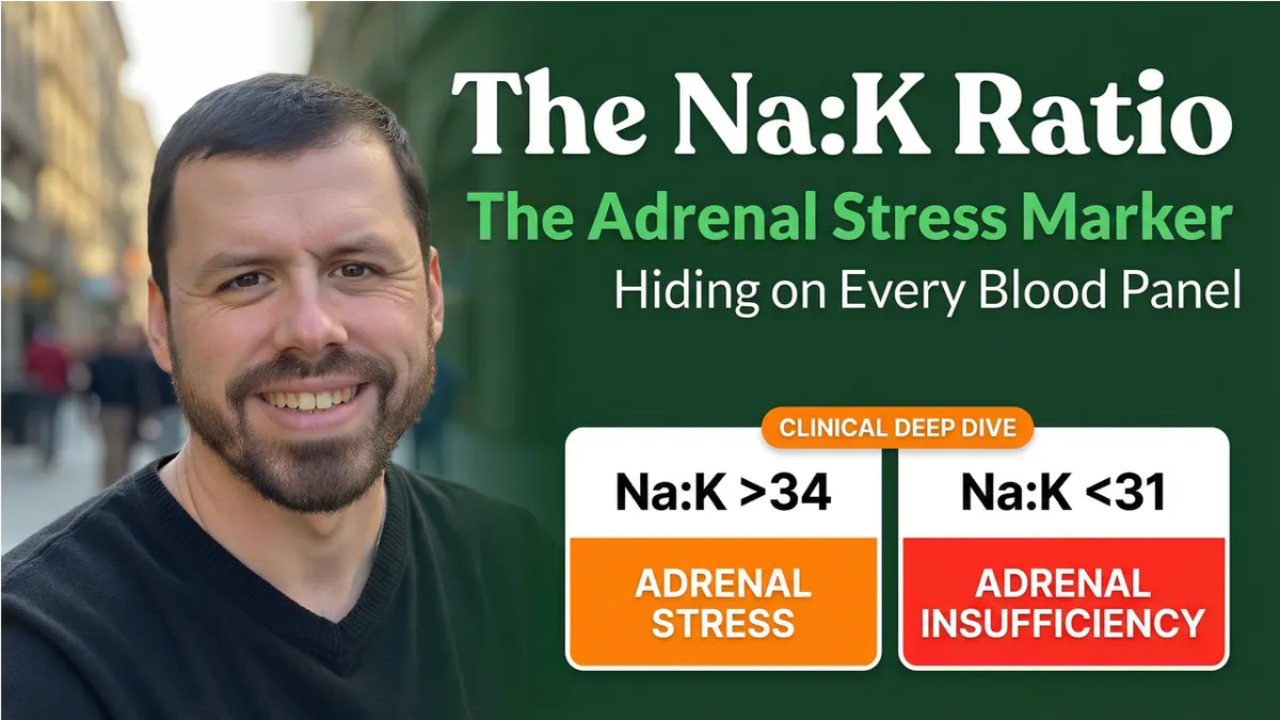
Clinical Deep Dive
The Na:K Ratio: The Adrenal Stress Marker Hiding on Every Blood Panel
Two Patterns, One Ratio & Why Stress Is the #1 Conversion Blocker
Sodium and potassium are on every comprehensive metabolic panel. Every practitioner has this data. Almost nobody calculates the ratio — and it’s one of the most clinically useful markers you’re not using. The sodium-to-potassium ratio provides a real-time window into adrenal function, aldosterone output, and the stress response — without ordering a single additional test.
This guide covers what the Na:K ratio tells you, the two primary adrenal patterns it reveals, how to confirm the pattern with the stress WBC signature, the downstream cascade that connects adrenal dysfunction to thyroid, sex hormones, blood sugar, and inflammation, and why addressing the stress axis is often the single highest-impact intervention you can make.
If you read the recent thyroid panel deep dive, you saw cortisol positioned as the #1 thyroid conversion blocker — the driver that shunts T4 to Reverse T3 instead of active T3. This post is the other side of that equation: how to identify the stress pattern that’s creating the conversion block in the first place.
What Is the Na:K Ratio and Why Does It Matter?
The sodium-to-potassium ratio is calculated by dividing serum sodium by serum potassium. Both electrolytes are under direct influence of the adrenal hormone aldosterone, which tells the kidneys to retain sodium and water while excreting potassium. When stress drives aldosterone output up, sodium rises and potassium drops — the ratio climbs. When chronic stress eventually depletes the adrenals and aldosterone output falls, sodium drops and potassium rises — the ratio falls.1
This is why the Na:K ratio functions as a real-time stress biomarker. It doesn’t require cortisol testing, salivary panels, or DUTCH tests (though those add depth). It’s sitting on the CMP you already have.
The sodium-potassium pump consumes approximately 30–35% of the body’s basal metabolic rate. Three sodium out, two potassium in — constantly. This is why electrolyte imbalances affect energy so profoundly. When stress disrupts aldosterone and the Na:K balance shifts, the ripple effects are systemic.
The Two Primary Adrenal Patterns
The Na:K ratio reveals two distinct adrenal states. The intervention for each is fundamentally different — which is why identifying the correct pattern before reaching for adaptogens matters.
Pattern 1: Adrenal Stress — Na:K >34
Electrolyte Signature: High sodium, low potassium
Mechanism: Elevated aldosterone from acute/active stress response
The “wired but tired” presentation. The adrenals are actively firing — cortisol and aldosterone are elevated, driving sodium retention and potassium excretion. The client may present with anxiety, difficulty winding down, elevated blood pressure, fluid retention, insomnia (especially difficulty falling asleep), and inflammatory symptoms. This is the compensated stage — the body is still mounting a stress response, but at a cost.2
Pattern 2: Adrenal Insufficiency — Na:K <31
Electrolyte Signature: Low sodium, elevated potassium
Mechanism: Depleted aldosterone from chronic stress exhaustion
The “burned out” presentation. The adrenals have been pushed for so long that output has declined. Aldosterone drops, sodium is lost, and potassium is retained. The client presents with profound fatigue, salt cravings, low blood pressure, dizziness upon standing (orthostatic hypotension), difficulty getting started in the morning, and a history of prolonged intense stress — caregiving, divorce, chronic illness, overwork. This is the decompensated stage.
Na:K Ratio Quick Reference
Optimal: 31–34
>34: Adrenal stress pattern (elevated aldosterone — acute/active stress)
<31: Adrenal insufficiency pattern (low aldosterone — chronic stress exhaustion)
How to Confirm the Pattern: The Stress WBC Signature
The Na:K ratio gives you the adrenal picture. The white blood cell differential gives you the confirmation. When chronic stress is present, cortisol reshapes the WBC pattern in a predictable way:
The Stress WBC Pattern
Neutrophils: Slightly elevated (60–65%) — cortisol mobilizes neutrophils
Lymphocytes: Slightly depressed (27–32%) — cortisol suppresses adaptive immunity
Eosinophils: Often 0–1% — low or absent eosinophils are common in stress patterns, but normal eosinophils don’t rule stress out
NLR (Neutrophil-to-Lymphocyte Ratio): Elevated (>2.0) — functional optimal is 1.3–2.0
Total WBC: Normal to slightly elevated (5.5–7.0)
Clinical Pearl
When you see Na:K >34 AND the stress WBC signature (elevated neutrophils, low lymphocytes, suppressed eosinophils, NLR >2.0), you have convergent evidence from two completely independent parts of the lab panel pointing to the same root cause. This kind of cross-panel pattern confirmation is what separates functional assessment from single-marker interpretation.
The Cortisol-DHEA-S Progression: Staging the Stress Response
Stress doesn’t create instant burnout. It progresses through stages, and the cortisol-to-DHEA-S relationship reveals where your client sits on the spectrum:3
An important nuance: the body can maintain adequate circulating cortisol levels by reducing cortisol metabolism — keeping hormones active longer while producing less overall. This adaptation can mask adrenal dysfunction on standard blood or saliva testing. DUTCH testing reveals the full picture by measuring metabolized cortisol, but the Na:K ratio and stress WBC pattern often catch the dysfunction even when serum cortisol looks “normal.”
The Downstream Cascade: What Chronic Stress Breaks
Chronic adrenal stress doesn’t stay contained to the HPA axis. It creates a cascade of dysfunction across virtually every system you assess in a blood panel:
Systemic Effects of Chronic Adrenal Stress
→ Thyroid: Cortisol is the #1 conversion blocker — shunts T4 to Reverse T3 instead of active T3. The HPA and HPT axes share two-thirds of their regulatory pathways. Stress-induced thyroid suppression is the pattern most practitioners miss.
→ Sex Hormones: Chronically elevated cortisol blunts GnRH from the hypothalamus, reducing LH and FSH from the pituitary. Without those signals, the gonads never receive instructions to produce sex hormones. The adrenals continue receiving ACTH while gonadal signaling is suppressed.4
→ Blood Sugar: Cortisol elevates glucose through gluconeogenesis and promotes insulin resistance. This creates a vicious cycle: stress drives insulin resistance, insulin resistance impairs thyroid conversion, low T3 reduces glucose uptake, worsening blood sugar further.
→ Inflammation: Chronic psychosocial stress stimulates systemic low-grade inflammation through neuroendocrine and behavioral pathways.5 Elevated aldosterone itself is considered a pro-inflammatory hormone.
→ Estrogen Dominance: High cortisol drives estrogen dominance through inflammation promotion, visceral fat accumulation, and increased aromatase activity. Visceral fat contains high concentrations of aromatase enzyme.
→ Immune Suppression: Cortisol suppresses lymphocyte activity, reduces eosinophils, and shifts the immune balance toward innate (neutrophil) dominance — visible on every CBC with differential.
This is why the Three-Tier Decision Tree places stress assessment at Tier 2 — after blood sugar but before inflammation. Stress is often the hidden driver behind thyroid conversion failure, hormonal imbalance, and persistent inflammatory patterns that don’t respond to direct intervention. For more on how the Decision Tree framework prioritizes clinical assessment, see Pattern Recognition in Blood Chemistry.
The Pregnenolone Steal Myth
Many practitioners were taught that chronic stress causes the body to “steal” pregnenolone from the sex hormone pathway to make more cortisol — the “pregnenolone steal” theory. This mechanism is a myth.
The actual mechanism is communication disruption, not substrate competition. Each organ produces its own pregnenolone based on signals from the hypothalamic-pituitary system. What actually happens during chronic stress is that elevated cortisol blunts GnRH from the hypothalamus, which reduces LH and FSH from the pituitary. Without those signals, the gonads never receive instructions to convert cholesterol to pregnenolone. The adrenals continue receiving ACTH signals while gonadal signaling is suppressed. It’s a signaling problem, not a supply problem. For the full breakdown, see The Pregnenolone Steal Myth.
Intervention Framework: Pattern-Specific Strategies
The intervention differs based on which pattern is present. Supporting an already-elevated stress response with stimulating adaptogens makes the problem worse, not better.
For Adrenal Stress (Na:K >34 / “Wired and Tired”)
→ Calming adaptogens: Ashwagandha (KSM-66) has been shown to reduce cortisol and improve stress resilience6
→ Phosphatidylserine at bedtime — supports cortisol clearance
→ Magnesium glycinate at bedtime — supports nervous system and sleep
→ Nervous system support: Liposomal GABA + L-theanine
→ Sleep optimization — adrenal recovery happens during sleep
→ Potassium-rich foods — counterbalance aldosterone-driven potassium depletion
For Adrenal Insufficiency (Na:K <31 / “Burned Out”)
→ Stimulating adaptogens: Rhodiola for energy recovery, holy basil for calming stimulation
→ B5 (pantothenic acid) + whole food vitamin C — adrenal substrate support
→ Adequate sodium intake — the body is losing sodium through low aldosterone; salt cravings are physiologically appropriate
→ Adequate calories and rest — the body is in conservation mode
→ Reduce exercise intensity — excessive exercise in a depleted state worsens the problem
Clinical Pearl
Interestingly, a low-salt diet can actually activate the sympathetic nervous system and stimulate aldosterone production. Research has found that a low-salt diet was associated with significantly increased serum aldosterone and with insulin resistance in healthy subjects.7 The salt-restriction advice commonly given to stressed clients may paradoxically worsen the adrenal pattern. Context matters — as it always does.
Case Study: “My Thyroid Protocols Aren’t Working”
42-Year-Old Female — Fatigue, Weight Gain, Anxiety, Insomnia
History: Previous practitioner identified low Free T3 and elevated Reverse T3. Started thyroid support protocols (selenium, zinc, iodine, ashwagandha). Three months later — no improvement. Came for a second opinion.
Lab Results:
Na: 143 mEq/L • K: 3.8 mEq/L • Na:K Ratio: 37.6 — Adrenal stress pattern
Neutrophils: 63% • Lymphocytes: 28% • Eosinophils: 0% — Stress WBC confirmation
NLR: 2.25 — Elevated above optimal (<2.0)
Free T3: 2.6 pg/mL • Reverse T3: 21 ng/dL — Conversion dysfunction confirmed
Fasting Glucose: 94 mg/dL • Fasting Insulin: 8 μIU/mL — Early metabolic stress
hs-CRP: 2.4 mg/L — Chronic low-grade inflammation
Why the thyroid protocols failed: The previous practitioner correctly identified the thyroid conversion problem but missed what was driving it. Na:K of 37.6 with suppressed eosinophils and an NLR of 2.25 reveals active adrenal stress as the root cause. The cortisol is shunting T4 to Reverse T3. No amount of selenium or thyroid support will fix the conversion while the stress axis remains activated. Address the stress response first — the thyroid often comes back online without direct thyroid intervention.
This is the Decision Tree in action: the stress axis (Tier 2) is driving the thyroid dysfunction (Tier 2) which is driving the inflammatory pattern (Tier 3). Fix the upstream driver, and the downstream markers follow. For more on this hierarchy, see The Complete Practitioner Guide to Insulin Resistance, which covers why Tier 1 (blood sugar) must be addressed before Tier 2.
⚠️ Referral Red Flags
Sodium below 130 or above 150 mEq/L requires medical evaluation. Potassium below 3.0 or above 5.5 mmol/L requires urgent evaluation. Persistent Na:K <28 with severe symptoms (extreme fatigue, weight loss, hypotension) may indicate primary adrenal insufficiency (Addison’s disease) and requires endocrine referral. Never confuse functional adrenal patterns with Addison’s disease — they are clinically distinct conditions requiring different management. See Scope of Practice.
Putting It All Together
The Na:K ratio transforms two routine electrolyte values into an actionable clinical insight. Combined with the stress WBC pattern and cortisol-DHEA-S staging, it provides a comprehensive stress axis assessment using markers already available on a standard CMP and CBC.
Tools like Blood Chem Studio auto-calculate the Na:K ratio and NLR, flag them against functional optimal ranges, and display them alongside thyroid, metabolic, and inflammatory markers — so the stress pattern and its downstream effects are visible in a single clinical view.
Relaunching Soon
Blood Chem 101 — Rebuilt From the Ground Up
New marker coverage (including the highly requested thyroid module), new material, and a clinical framework built on the 8-Step Process and Three-Tier Decision Tree. The Na:K ratio, stress WBC patterns, and the adrenal-thyroid connection are all inside.
Frequently Asked Questions
How do I calculate the Na:K ratio?
Divide serum sodium by serum potassium. For example: sodium 140, potassium 4.2 = ratio of 33.3 (optimal). Sodium 143, potassium 3.8 = ratio of 37.6 (adrenal stress pattern). It takes seconds and the data is on every CMP.
Can medications affect the Na:K ratio?
Yes. Diuretics, ACE inhibitors, ARBs, potassium-sparing medications, corticosteroids, and laxatives can all shift the sodium-potassium balance. Always assess medication effects before attributing the ratio to adrenal dysfunction. For a full overview of medication interactions with lab values, see How Medications Distort Lab Interpretation.
Is the Na:K ratio a substitute for cortisol testing?
It’s not a substitute — it’s a complementary screening tool. The Na:K ratio reflects aldosterone-driven electrolyte shifts, which are influenced by but not identical to cortisol dynamics. For a comprehensive stress axis assessment, the Na:K ratio + stress WBC pattern provides the screening picture, and DUTCH testing adds the depth when needed.
Why do my clients with adrenal insufficiency crave salt?
Because their body is losing sodium. Low aldosterone output means the kidneys aren’t retaining sodium effectively. The salt craving is a physiologically appropriate signal — the body is trying to compensate for a real electrolyte deficit. In these clients, restricting salt can make the problem worse.
What’s the connection between stress and thyroid conversion?
Cortisol upregulates D3 enzyme activity, which converts T4 to Reverse T3 (inactive) instead of Free T3 (active). It simultaneously downregulates D1/D2 activity, reducing active T3 production. The result is hypothyroid symptoms despite “normal” TSH and adequate T4. For the full thyroid assessment framework, see How to Interpret a Thyroid Panel: Beyond TSH.
References
- Wardle, E. N. (2019). Guide to signal pathways in immune cells. Springer. [Na:K ratio clinical significance: >34 suggests potassium depletion/acute stress; <28 suggests sodium depletion/adrenal insufficiency]
- Ekun, O. A., Oloruntoba, A., et al. (2020). Assessment of plasma sodium to potassium ratio, renal function, markers of oxidative stress, inflammation, and endothelial dysfunction in Nigerian hypertensive patients. International Journal of Hypertension, 2020, 6365947.
- Kalantaridou, S. N., Makrigiannakis, A., Zoumakis, E., & Chrousos, G. P. (2004). Stress and the female reproductive system. Journal of Reproductive Immunology, 62(1–2), 61–68.
- Kalantaridou, S. N., et al. (2004). [Same study] Chronic stress and elevated cortisol suppress GnRH, LH, FSH, and sex hormone production.
- Rohleder, N. (2014). Stimulation of systemic low-grade inflammation by psychosocial stress. Psychosomatic Medicine, 76(3), 181–189.
- Chandrasekhar, K., Kapoor, J., & Anishetty, S. (2012). A prospective, randomized double-blind, placebo-controlled study of safety and efficacy of a high-concentration full-spectrum extract of ashwagandha root in reducing stress and anxiety in adults. Indian Journal of Psychological Medicine, 34(3), 255–262.
- Garg, R., Williams, G. H., Hurwitz, S., Brown, N. J., Hopkins, P. N., & Adler, G. K. (2011). Low-salt diet increases insulin resistance in healthy subjects. Metabolism, 60(7), 965–968.
Michael Rutherford • Wholistic Health Academy • wholistichealthacademy.org
